
Learn how to choose the right metrics, quantify uncertainty, and assess ranking robustness - so your image analysis models go beyond benchmarks and stand up in real-world applications.

This course is offered by Helmholtz Imaging in cooperation with HIDA
Helmholtz Imaging
Helmholtz Imaging’s mission is to unlock the potential of imaging in the Helmholtz Association across all research fields along the entire imaging pipeline, to improve leverage and accessibility of the innovative imaging modalities, application and data treasures, and to enable the delivery of generalizable imaging solutions. All scientists can contact the platform for direct support for imaging-related inquiries or the connection with other imaging experts from Helmholtz.
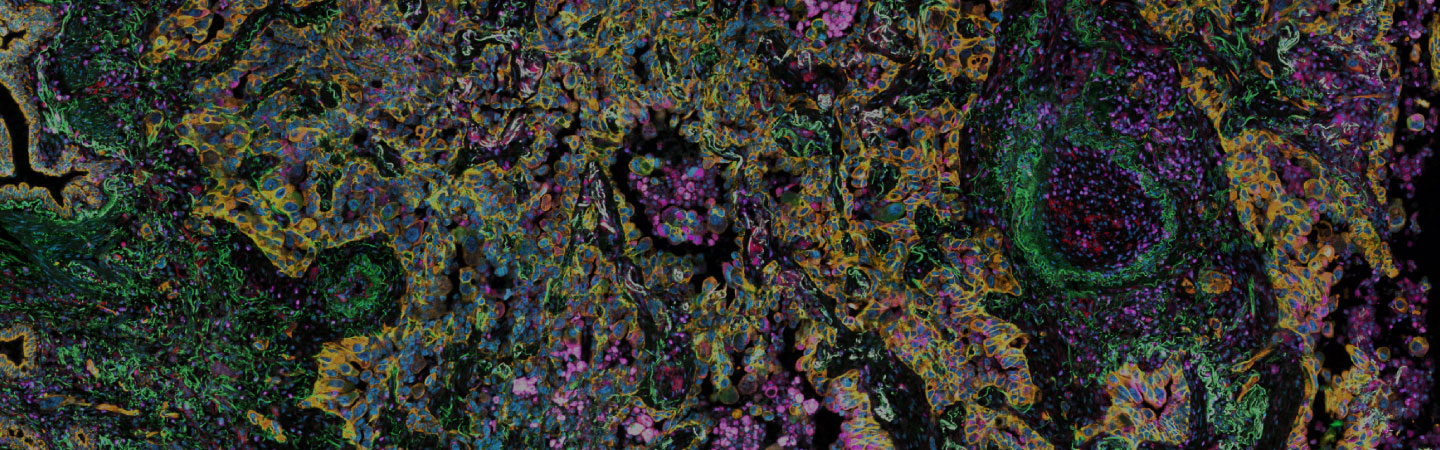
Credit: Sonja Fritzsche, MDC
Image description: A highly detailed, abstract-looking microscopy image filled with tightly packed, irregular cell-like shapes. The scene is dominated by bright orange and blue outlines, with green streaks and patches weaving through the tissue, plus many small pink and purple clusters scattered throughout. The background is mostly black, which makes the fluorescent colors stand out strongly. Information about the image: To develop novel strategies targeting the tumor microenvironment in lung adenocarcinoma, the TME was stained for cell type specific markers and imaged on an Axioscan 7 Slidescanner.
This three-day online workshop provides an introduction to the validation of AI methods in image analysis. Reliable validation is essential to decide whether algorithms have a potential for real-world translation, beyond standard leaderboards. It ensures that model performance estimates are meaningful, reproducible, and reflecting the underlying research questions. The course introduces key principles and practical techniques for validating AI models.
Participants will learn how to select and interpret appropriate performance metrics (Day 1), quantify model performance uncertainty (Day 2), and assess the robustness of rankings in algorithm benchmarking (Day 3).
The workshop combines theoretical lectures with guided hands-on exercises using provided datasets and Jupyter notebooks. We will use open tools such as Metrics Reloaded to map certain problems to suitable metrics, and Rankings Reloaded to assess ranking stability, along with new concepts to assess the probability of false outperformance claims in publications. In addition, short coding tasks will target the implementation and critical assessment of validation workflows.
After completing the workshop, participants will have a thorough understanding of core validation concepts and will be able to apply them in their own AI-based image analysis projects. They will be able to justify metric choices, quantify performance uncertainty, and communicate ranking robustness, which are crucial for publication, regulatory dialogues, and real-world deployment.
Learning goals
The course aims to provide participants with both conceptual understanding and practical skills for reliable validation of AI-based image analysis methods. Each day focuses on a different key aspect of validation, combining theoretical input with hands-on coding exercises.
Day 1: Metrics
- understand the role of performance metrics in validating AI-based image analysis methods
- identify suitable, task-specific metrics and explain their assumptions and limitations
- compute and interpret multiple metrics using open source libraries and toolkits
Day 2: Uncertainty
- describe sources of performance uncertainty in AI model validation
- compute and interpret performance uncertainty measures such as the standard deviation and confidence intervals
Day 3: Rankings
- analyse and interpret ranking stability in benchmarking studies and assess the probability of false outperformance claims in publications;
- apply best practices for reporting.
Course date
For more information on how to register, please follow the link on the course date.
Prerequisites
To participate in this course, you need to know
- basic knowledge of image analysis and machine learning
- basic Python programming skills
Target group
- Graduate and PhD students working with and/or interested in AI in image analysis
- Researchers and engineers developing or validating AI-based image analysis models
- Scientists interested in reliable validation and reproducible evaluation practices
- Anyone who wants to gain practical experience with metrics, uncertainty estimation and ranking analysis in AI
This course is free of charge.
The Data Science Course Portfolio
This course is part of the Data Science Course Portfolio, curated by the five Helmholtz Information & Data Science Platforms - Helmholtz AI, Helmholtz Imaging, HIDA, HIFIS, HMC. Find out more on the Course Portfolio here.
