
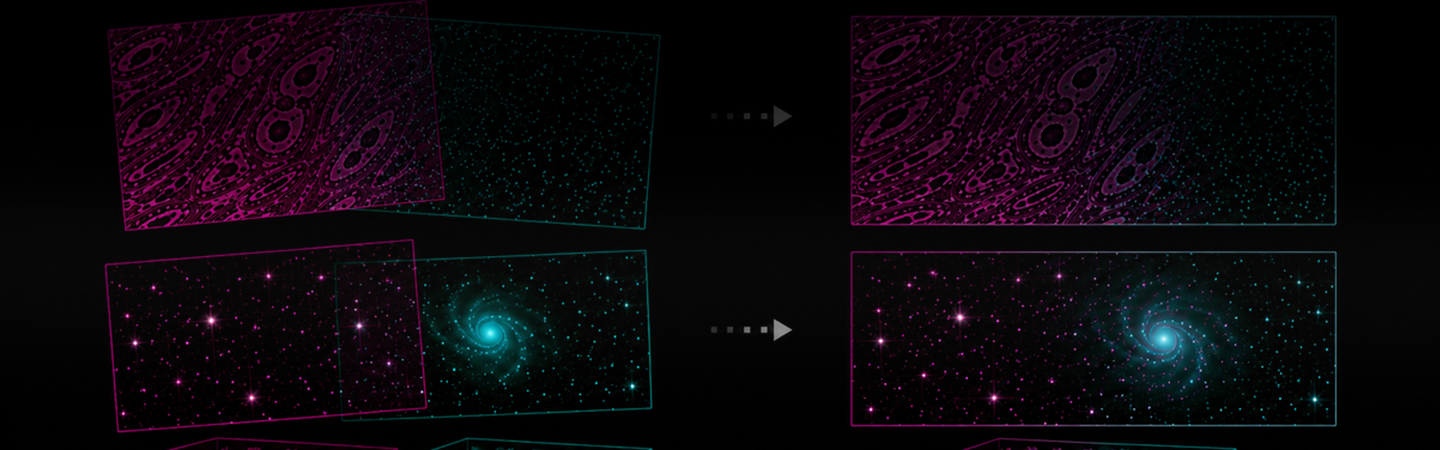
This course explores how image registration powers research across disciplines — combining classic methods with deep learning to align and analyze complex visual data.

This course is offered by Helmholtz Imaging in cooperation with HIDA
Helmholtz Imaging
Helmholtz Imaging’s mission is to unlock the potential of imaging in the Helmholtz Association across all research fields along the entire imaging pipeline, to improve leverage and accessibility of the innovative imaging modalities, application and data treasures, and to enable the delivery of generalizable imaging solutions. All scientists can contact the platform for direct support for imaging-related inquiries or the connection with other imaging experts from Helmholtz.
The header picture was AI generated with ChatGPT
This workshop explores fundamental concepts and practical techniques for image registration, focusing on applications in microscopy, material science, and earth science. Image registration is the process of aligning multiple datasets into a common coordinate system, enabling accurate comparison and analysis.
This workshop will be an hour and a half and will include classical approaches as well as deep learning approaches.
Learning goals
By the end of the course, you will be able to:
-
Understand the purpose of image registration and its common needs in research across various fields like microscopy, medical imaging, earth science, and material science.
-
Identify different image transformation types (e.g., rigid, affine) and understand their application.
-
Explain the reason for and common types of image interpolation used in image transformation.
-
Understand and apply integrated image registration techniques, including Intensity-Based, Feature-based approaches, and Deep Learning-Based Registration.
-
Understand techniques for 3D registration, such as aligning slices in a stack.
-
Recognize challenges and considerations in image registration, such as method selection, transformation type, and preprocessing.
-
Be aware of available software tools and libraries for image registration.
Course date
Register now:
For more information on how to register, please follow the link on the course date.
Prerequisites
While there are no formal prerequisites, a basic understanding of what digital images are (i.e., as matrices of pixel intensities) and some prior coding experience would be beneficial.
Target group
This course is aimed at Helmholtz scientists who work with images and want to learn how to spatially align them.
Instructor
Ella Bahry (Helmholtz Imaging, MDC)
This course is free of charge.
The Data Science Course Portfolio
This course is part of the Data Science Course Portfolio, curated by the five Helmholtz Information & Data Science Platforms - Helmholtz AI, Helmholtz Imaging, HIDA, HIFIS, HMC. Find out more on the Course Portfolio here.
