
This seminar series covers six key image processing tasks, following a typical workflow from reconstruction to segmentation, denoising, and tracking. It includes lectures and discussions on various techniques, with a focus on practical application.

This course is offered by Helmholtz Imaging in cooperation with HIDA
Helmholtz Imaging
Helmholtz Imaging’s mission is to unlock the potential of imaging in the Helmholtz Association across all research fields along the entire imaging pipeline, to improve leverage and accessibility of the innovative imaging modalities, application and data treasures, and to enable the delivery of generalizable imaging solutions. All scientists can contact the platform for direct support for imaging-related inquiries or the connection with other imaging experts from Helmholtz.
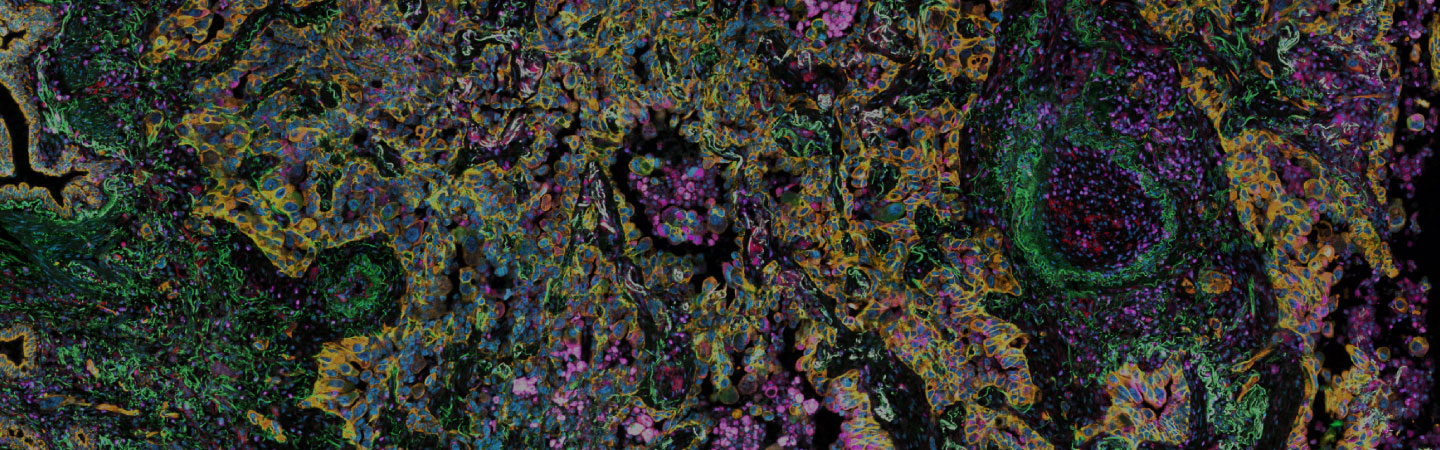
Credit: Sonja Fritzsche, MDC
Image description: A highly detailed, abstract-looking microscopy image filled with tightly packed, irregular cell-like shapes. The scene is dominated by bright orange and blue outlines, with green streaks and patches weaving through the tissue, plus many small pink and purple clusters scattered throughout. The background is mostly black, which makes the fluorescent colors stand out strongly. Information about the image: To develop novel strategies targeting the tumor microenvironment in lung adenocarcinoma, the TME was stained for cell type specific markers and imaged on an Axioscan 7 Slidescanner.
Images are not always captured by a camera. Often, they must be tediously reconstructed from a series of projections or other non-image types of acquisitions.
Different reconstruction algorithms allow for better image quality or can focus on specific properties of the objects under observation. Noise can be introduced at many steps in the image acquisition process. Denoising is therefore an essential step in most image processing workflows. Tracking individual objects over multiple time steps is a difficult task, but allows for the observation of temporal dynamics. Segmentation refers to the assignment of each pixel in an image to a specific category. In semantic segmentation, all pixels belonging to a cat are labeled "cat", and all pixels belonging to trees are labeled "tree". In instance segmentation, each pixel is additionally assigned to an object instance, making it possible to distinguish multiple cats and trees in an image.
The visualization of otherwise difficult-to-interpret data, such as reconstructed 3D(+T) objects or high-dimensional image data, is essential for understanding the results. Finally, interpreting the results of AI-based image analysis algorithms is important: Why was a particular decision made? What structures in the images were responsible? What can AI tell us about the underlying problem?
The course consists of lectures and interactive discussions. It covers various image processing techniques. It is recommended to attend all lectures for a deep understanding of the subject.
Learning goals
By the end of the course, you will have a basic understanding of the following six image processing techniques:
- reconstruction
- denoising
- tracking
- segmentation
- visualization
- AI-based image analysis
Course date
New course dates and more information will be published in the course of 2026.
Target group
This course is open to researchers of all career stages, or anyone interested in learning about the subject. Course seats are limited.
This course is free of charge.
The Data Science Course Portfolio
This course is part of the Data Science Course Portfolio, curated by the five Helmholtz Information & Data Science Platforms - Helmholtz AI, Helmholtz Imaging, HIDA, HIFIS, HMC. Find out more on the Course Portfolio here.
